Category: Showcase

THE DEVIL’S SON by Charles Kowalski (Showcase, Interview & Giveaway)

The Devil’s Son

by Charles Kowalski

on Tour November 19 – December 21, 2018

Synopsis:

The Devil's Son by Charles Kowalski


The son of a notorious Nazi fugitive is running for U.S. President. A Secret Service Agent sworn to protect him meets a beautiful Mossad spy determined to stop him.


Book Details:

Genre: Political, Espionage thriller
Published by: Seabridge Press
Publication Date: July 24, 2018
Number of Pages: 333
ISBN: 1724248731 (ISBN13: 9781724248732)
Purchase Links: Amazon | Goodreads


Author Bio:

Charles Kowalski

Charles Kowalski is an active member of International Thriller Writers. His debut thriller, MIND VIRUS, won the Rocky Mountain Fiction Writers’ Colorado Gold Award, and was a finalist for Killer Nashville’s Silver Falchion Award for Best Thriller of 2017. His latest, THE DEVIL’S SON, was shortlisted for the 2018 Adventure Writers’ Competition Grandmaster Award. He divides his time between Japan, where he teaches at a university, and Downeast Maine.

Catch Up With Charles Kowalski On:
Website, Goodreads, Twitter, & Facebook!


Q&A with Charles Kowalski

Welcome!
Writing and Reading:

Do you draw from personal experiences and/or current events?

I started this book by drawing from current events, but then current events caught up with the book – and overtaken it, in frightening ways that I couldn’t have foreseen. As C.S. Lewis once said, “The trouble with writing satire is that the real world always anticipates you, and things that were meant as exaggerations turn out to be nothing of the sort.”

Do you start with the conclusion and plot in reverse or start from the beginning and see where the story line brings you?

I start with a concept. When I sit down to write, I start from the beginning and have a fair idea where the story will go. I don’t start unless I can see the ending, but invariably, there are twists and turns on the way that take me by surprise.

Are any of your characters based on you or people that you know?
Any similarity to any actual persons, events, or presidents is purely coincidental.

Your routine when writing? Any idiosyncrasies?

I have a full-time job and a family, so I write in stolen moments – on trains, in cafes, in the office after the day’s work is done, or at home after everyone has gone to bed. I often get my best ideas when I’m in motion, either going for a walk or performing some mindless task, so I’ll often have my laptop on the kitchen counter when washing the dishes or hanging the laundry, just in case inspiration strikes.

Tell us why we should read this book.

To make sure it stays in the fiction section.

Who are some of your favorite authors?

I’ve been inspired by other writers of thrillers with a religious angle, like Dan Brown and Daniel Silva. I’ve also been encouraged by other Japan-based thriller writers whose scope has expanded worldwide, like Barry Eisler and Barry Lancet; I hope I can do the same, even though my name isn’t Barry!

What are you reading now?

I’m eagerly looking forward to starting the Detective Hiroshi series by a fellow Japan-based author, Michael Pronko.

Are you working on your next novel? Can you tell us a little about it?

After two highly charged, research-intensive thrillers, MIND VIRUS and THE DEVIL’S SON, I’m working on something lighter and hopefully non-controversial: a middle-grade historical fantasy set in 17th century Japan, featuring Simon Grey, an English boy who runs away to sea to escape from his “gift” of seeing ghosts.

Fun questions:
Your novel will be a movie. Who would you cast?

Gal Gadot as Rachel. As for Henry Hale, Aaron Eckhart says he doesn’t want to play any more villains, but I hope he’d make an exception.

Favorite leisure activity/hobby?

Besides writing? Or did you mean “favorite means of procrastination”? I confess before the assembly of the faithful that I’m more easily distracted by the siren song of social media (that counts as writing, right?) and Netflix (that counts as research, right?) than I would like to be.

Favorite meal?

My default lunch on a busy writing day is spaghetti pepperoncino made with habanero-infused olive oil. Definitely not for the faint of heart!

Thank you for stopping by CMash Reads and spending time with us.


Read an excerpt:

BUENOS AIRES, ARGENTINA
1960

Azriel “Azi” Horowitz grimaced as his partner’s Zippo flared in the darkness beside him. He had never been a smoker, and in the confines of the Ford Mainline – a clunker, but the best rental they could find, and not out of place in the working-class Olivos neighborhood in Partido Vicente Lopez – the fumes from the Lucky Strikes nauseated him.

“Yaki, you know I have a little problem with noxious gases in closed spaces.”

Yaakov Lavan shrugged, with his usual easygoing grin. “We’re just two old friends having a chat, right, Azi? And we have to do it in the car, because my wife won’t let me smoke near the baby.”

Horowitz had to concede the point, although he still thought it was a rather thin cover story. One small mercy of operating in Argentina was that the sight of two men conversing in a parked car at night was not altogether uncommon, but every little extra touch of realism they could add was vital. If anyone accosted them, they would have a lot more explaining to do than either of them could manage in Spanish.

Lavan took a deep drag from his cigarette, held it for a moment, and slowly exhaled a white cloud with a look of supreme contentment. As much as Horowitz hated the smell of tobacco, he felt a touch of envy for his partner, and wished he had some similarly portable means of calming his own nerves. His mind continually flitted over the long journey that had brought them to this moment – the years of detective work that had traced their targets to Argentina, the months of secretly stalking and planning in their theater of operations – and all the hundreds of things that could still go wrong.

In addition to the unease in his mind, Horowitz felt another kind in his body: he desperately needed a bathroom break. Thanks to one of the men they were waiting for, his kidneys had stopped growing at the age of seven.

Their targets called themselves Carlos Vasquez and José Mendoza, and had the identity cards to prove it, but Horowitz had first made their acquaintance under different names. One was SS Hauptsturmführer Karl Weiss, #7278, the sadistic Lagerführer – deputy commandant – of Auschwitz. The other, holding the same SS rank, was Josef Mengele, #317885, a living desecration of the title of “doctor.” Anyone who had ever passed through the gates of Auschwitz knew him by yet another name: der Totesengel, the Angel of Death.

If all goes well, Horowitz thought, tonight will be a night for the history books. With luck and the blessing of the Almighty, they would soon have their targets in hand and be on their way to the safe house code-named Tira – “castle” in Hebrew – where Mengele and Weiss would go straight into an improvised holding cell, to join the worst of the worst: SS Obersturmbannführer Adolf Eichmann, “the Master,” architect of the Holocaust, personally responsible for the murder of millions.

The Israeli government naturally regarded Eichmann as the grand prize, but Horowitz had a personal score to settle with Mengele and Weiss. As soon as the cattle car arrived in Auschwitz, Weiss had sent Horowitz’s mother and father directly to the gas chambers, but knowing Mengele’s notorious fascination with twins, kept Azriel and his sister Rachel alive as subjects for his experiments. Mengele had tried to change Rachel’s eye color by injecting her eyeballs with a substance that left her blind, and then infected her with typhus, keeping a careful record of her wasting away. When her end was near, rather than let the disease claim her, Mengele passed her on to Weiss, who used her in one final experiment to see how long it would take to die from a new type of lethal injection.

It had taken twelve minutes and nineteen seconds before she stopped screaming.

“Look,” came Lavan’s voice, bringing Horowitz sharply back to the present. “Is that them?”

Horowitz gazed through the windshield and saw two figures staggering tipsily along the route from the Hofbräuhaus, the German restaurant Mengele and Weiss were known to frequent, towards the guest house where they lived. At first, the darkness and distance made it impossible to make out their features. Then they stepped into the light of a street lamp, and Horowitz risked a quick glance through his binoculars. At the sight of their faces, he felt a sudden burning pain in his left forearm.

Fifteen years had passed since Horowitz last saw those faces, but there could be no mistaking the granite jaw and ice-blue eyes of Weiss. Nor was there any doubt about the gap-toothed smile that gave Mengele the appearance of a little boy – one who delighted in torturing anything smaller and weaker than himself. Many children in Auschwitz had seen that smile on the face of their self-proclaimed “Uncle Josef” as he sat them on his knee, gave them sweets, stroked their hair – and in a soft, soothing voice, ordered an aide to inject them with poison.

“It’s them,” Horowitz said.

“You’re sure?”

“Positive.”

Lavan stubbed out his cigarette. He turned around in the driver’s seat, pointed a hooded flashlight at the car behind them, and gave it two quick on-off bursts. The crew in the second car would relay the signal to Tabor and Rosen, who were waiting around the corner.

Right on cue, they appeared a moment later, Tabor in a suit and fedora, Rosen in a coat that would allow her ample freedom of movement. They sauntered toward Mengele and Weiss, with the same relaxed, unsteady gait as their targets, pretending to be absorbed in conversation, occasionally leaning on each other for support. To all appearances, they were a couple coming home from a party with a few too many drinks under their belts, too wrapped up in each other to take much notice of their surroundings.

They would maintain this masquerade until they passed their targets, right between the two cars. Then they would turn and grab them from behind, as the driver of the rear car switched on the high beams to blind them. Horowitz, and the other strongman in the rear car, would jump out and help Tabor and Rosen subdue their targets and bundle one of them into each car. They would apply an ether mask to knock them out, and the two cars would take off on separate routes to Tira, where they and their captives would stay until the plane was ready to take them all back to Israel.

And then, Horowitz thought, all the stories you thought would lie buried with your victims will be told to the world, from a courtroom in Jerusalem. The world will know what we mean when we say, “Never forget.”

He pulled on a pair of gloves. The May night was chill enough to warrant them, but more than that, he might have to use his hand to muffle Weiss’s screams. It revolted him to think of his bare hands touching the mouth that had ordered his parents gassed and his sister tortured to death.

Tabor and Rosen were fifty paces away from their targets and closing.

Forty paces.

Thirty.

Horowitz heard the roar of a motorcycle approaching from behind. He tensed, and took an anxious glance in the rear-view mirror. The last thing they needed at this moment was for the police to pass by. The upcoming celebrations for Argentina’s hundred-fiftieth anniversary, which had all of Buenos Aires in a festive mood, had proven to be a double-edged sword for Horowitz and his team. The diplomatic entourage from Israel, one of many visiting from all over the world, had provided the perfect cover, but the influx of high-level international visitors also meant the constant menace of police patrols and checkpoints. The Mossad team was conducting this operation without the knowledge or approval of the Argentine government, and if they were found out, they might well go to jail. And, far worse, their targets might well go free.

The motorcycle passed by the lead car. Horowitz took a sidelong glance and saw no police insignia, just a single rider driving rather unsteadily. He breathed a little easier, but his heart was still pounding.

Twenty paces.

Ten.

“Get ready to meet the real Angel of Death, you sons of bitches,” Horowitz muttered aloud.

***

Excerpt from The Devil’s Son by Charles Kowalski. Copyright © 2018 by Charles Kowalski. Reproduced with permission from Charles Kowalski. All rights reserved.


Tour Participants:

Visit these other great hosts on this tour for more great reviews, interviews, guest posts, and giveaways!


Enter to win!

This is a rafflecopter giveaway hosted by Partners in Crime Virtual Book Tours for Charles Kowalski. There will be 1 winner of one (1) Amazon.com Gift Card. The giveaway begins on November 19, 2018 and runs through December 22, 2018. Void where prohibited.

a Rafflecopter giveaway


Get More Great Reads at Partners In Crime Virtual Book Tours


Beyond The Truth by Bruce Robert Coffin (Showcase & Giveaway)

Beyond the Truth

by Bruce Robert Coffin

on Tour November 1-30, 2018

Synopsis:

Beyond the Truth by Bruce Robert Coffin

In this latest enthralling mystery from #1 bestselling author Bruce Robert Coffin, Detective Sergeant John Byron faces the greatest challenge of his career.

When a popular high school senior is shot by police following a late night robbery, chaos ensues. The actions of the officer are immediately called into question. Amid community protests, political grandstanding, department leaks, and reluctant witnesses, Byron and his team must work quickly to find the missing pieces.

And when an attempt is made on the officer’s life, Byron shifts into overdrive, putting everything on the line. Was the attack merely retribution or something more sinister? The search for the truth may come at a price not even Byron can afford.

Book Details:

Genre: Mystery
Published by: Witness Impulse
Publication Date: October 30, 2018
Number of Pages: 448
ISBN: 0062569511 (ISBN13: 9780062569516)
Series: Detective Byron #3
Purchase Links: Amazon | Barnes & Noble | Goodreads


Read an excerpt:

Veteran Portland police officer Sean Haggerty trudged across the deserted parking lot beneath the bright sodium arc lights of the 7-Eleven. His breath condensed into small white clouds before drifting away on the frigid night air. The thin layer of ice and snow covering the pavement crunched under his highly polished jump-boots as he approached the idling black and white. Only two more hours until the end of his overtime. After four months in his new assignment as School Resource Officer for Portland High School, it felt good to be back in a patrol car, even if it was only one shift. Balancing a large styrofoam coffee cup atop his clipboard, he was reaching for the cruiser keys on his belt when static crackled from his radio mic.

“Any unit in the area of Washington Avenue near the Bubble Up Laundromat please respond,” the dispatcher said.

The Bubble Up was in Haggerty’s assigned area, less than a half mile up the street, but Dispatch still listed him as busy taking a shoplifting report. Someone had snatched a twelve pack of beer.

Haggerty unlocked the door to the cruiser then keyed the mic.

“402, I’m clear the 10-92 at 27 Washington. I can cover that.”

“Ten four, 402,” the dispatcher said. “Standby. 401.”

“401, go.”

“And 421.”

“Go ahead.”

Haggerty knew whatever this was, it was a priority. Dispatch did not send two line units and a supervisor for just any call.

“402, 401, and 421, all three units respond to the Bubble Up Laundry at 214 Washington Avenue for an armed 10-90 that just occurred.”

As Haggerty scrambled into the cruiser, the styrofoam cup tumbled to the pavement, spilling its contents. The coffee froze almost instantly.

“Dammit,” Haggerty said.

He tossed his clipboard onto the passenger seat, then climbed in. Allowing for the possibility of a quick exit, he ignored the seatbelt requirement and threw the shift lever into Drive. He powered down his portable radio and reached for the microphone clipped to the dashboard. “402, en route.”

“421 and 401 responding from the west end,” the sergeant said, acknowledging the call for both backup units.

Haggerty pulled out of the lot onto Washington Avenue, and headed outbound toward Tukey’s Bridge. He drove without lights or siren, in hopes of catching the suspects by surprise.

“402,” Haggerty said, his eyes scanning the dark sidewalks and alleys. “Any description or direction of travel?”

“Ten four, 402. We have the victim on the phone. Suspects are described as two masked males. Suspect number one was wearing a black hoodie and blue jeans, carrying a dark colored backpack. Suspect two was dressed in dark pants and a red hoodie, with some kind of emblem on it. Unknown direction of travel.”

“Is the victim injured?” Haggerty asked, trying to decide whether to go directly to the scene, securing the laundromat, or take a quick spin around the area first to try and locate the suspects.

“Negative, 402,” the dispatcher said. “Just shaken up.”

“What was the weapon used?”

“Standby, 402.”

Haggerty caught a flash of red up ahead in the beam of the cruiser’s headlights as two figures darted from his right across Washington Avenue down Madison Street. He accelerated, flicked on the emergency lights and siren, and keyed the dash mic again.

“402, I have a visual on the two suspects near Washington and Madison. They just rabbited into Kennedy Park.”

“Ten four. 401 and 421, copy?” the dispatcher said.

“Copy.”

Braking hard, Haggerty spun the steering wheel left, making the turn onto Madison. He knew if he didn’t stay right on them that he would lose them among the project’s many apartments and row houses. The hooded figures sprinting down the hill were already several hundred feet ahead. He punched the gas and the cruiser shot after them. He was beginning to close the gap when they cut left in front of an oncoming car onto Greenleaf Street.

“Greenleaf toward East Oxford,” he shouted into the mic, trying to be heard above the wail of his cruiser’s siren as he raced through the built-up residential neighborhood.

The Ford skidded wide as he turned onto Greenleaf. Haggerty fought the urge to over-steer, waiting until the cruiser’s front tires found purchase on a bare patch of pavement and it straightened out.

The two figures were clearer now, about fifty feet ahead. He was nearly on top of them when they turned again, west, running between rows of apartment buildings.

“They just cut over toward Monroe Court,” Haggerty said.

“Ten four,” the dispatcher said. “421 and 401, copy?”

“Copy,” 421 acknowledged.

Haggerty accelerated past the alley the suspects had taken, hoping to cut them off by circling the block and coming out ahead of them on East Oxford Street. He turned right onto Oxford just in time to see them run across the road and duck between yet another set of row houses.

He rode the brake, and the pulse of the anti-lock mechanism pushed back against his foot. The black and white felt as if it were speeding up. Ice. Shit. The rear end started to swing to the right toward a line of parked cars. He eased off the brake and the Ford straightened out but was now headed directly toward a snowbank in front of the alley—an ice bank, really. Still traveling about five miles per hour, the black and white smashed into it with a crunch. Haggerty jumped from the car and gave chase, the door still open, the siren still blaring. He would have to answer for a mangled squad car later, but there was no time to think of that now. The snow piled against the apartment building walls seemed to dance in the flickering blue light of his cruiser’s strobes, making the alley look like a disco.

Haggerty could just make out the two hooded figures in the bobbing beam of his mini MagLite as he ran.

“Police! Stop!” he yelled. They didn’t.

He was gaining on them when his boot struck something buried beneath the snow, and he sprawled headfirst to the ground. Scrambling to regain his feet, he stood and quickly scanned the area for his flashlight, but it was gone. He turned and hurried down the dark alley, keying his shoulder mic as he went.

“402, 10-50,” he said, referring to his cruiser accident. “I’m now in foot pursuit of the 10-90 suspects. Toward Cumberland from East Oxford.”

“Ten-four, 402,” the female dispatcher acknowledged. “1 and 21, copy.”

Haggerty heard the distorted transmissions as both units responded simultaneously, causing the radio to squeal in protest. He rounded the rear corner of a three-story unit just in time to see the suspect wearing the red hoodie stuck near the top of a six-foot chain-link fence. The other figure had already made it over and stopped to assist.

“Freeze,” Haggerty yelled as he drew his weapon.

Neither suspect heeded his warning. Haggerty was at full stride, gun at the low ready position, about fifteen feet from the fence, when the first suspect finally pulled the second one loose. Up and over they went leaving Haggerty on the wrong side of the barrier.

Damn! Haggerty holstered his Glock, then backed far enough away from the fence to give himself a running start. He hit the fence, left foot out in front, reaching for the top with his gloved hands, and then vaulted up and over it with ease. The suspect in the dark-colored hoodie turned and looked back, giving Haggerty a glimpse of what seemed to be a ski mask made to look like a skull. Thirty feet now. He was closing the distance again.

If they don’t split up I’ll have a chance, he thought. He heard a dog barking frantically nearby, and the distant wail of approaching sirens. The combination of the cold air into his lungs and the adrenaline surge were beginning to take their toll, sapping his strength. His arms and legs were slowing, despite his efforts.

“What’s your twenty, 402?” the dispatcher asked. His location.

“Fuck if I know,” he said out loud and breathless. He keyed the mic on his shoulder. “Back yards. Headed west. Toward Anderson.”

“Ten-four.” The dispatcher said. “Units copy?”

“1 copies.”

“21, I copy,” the sergeant said. “The call came in as an armed 10-90. What was the weapon?”

“Standby, 21.”

Haggerty lost them again as they rounded another building. He slowed to a jog and drew his sidearm again. The alley was pitch back and he didn’t want to risk running into an ambush.

“Units be advised, the original caller was a customer who walked in on the robbery. I have the victim on the phone now. He says the male in the dark-colored hoodie displayed a silver colored 10-32 handgun.”

“21, give us a signal,” the sergeant said.

“10-4,” the dispatcher said. The familiar high-pitched tone sounded twice over the radio before the dispatcher spoke again. “All units, a signal one thousand is now in effect. Hold all air traffic or switch to channel 2. 401, 402, and 421 have priority.”

Haggerty stepped forward carefully, not wanting to trip again. His lungs were burning. He attempted to slow his breathing while waiting for his eyes to adjust to the darkness. He froze in place as he heard a banging sound, as if someone were striking a solid object with a bat. The sound was followed by shouting, but he couldn’t make out what was being said.

Peeking quickly around the corner of the building, he saw the figure in the red hoodie kicking at the stuck gate of a wooden stockade fence, while the other had scrambled onto the roof of a junk car and was attempting to climb over the barrier.

“Freeze,” Haggerty yelled, aiming his Glock at the dark hooded figure standing atop the car. Red Hoodie stopped kicking, but didn’t turn back toward Haggerty. The suspect on the car, also facing away from him, didn’t move. Haggerty approached the fence cautiously, making sure of his footing as he planted one foot in front of the other. His eyes shifted between the two figures, but he kept his gun trained on the suspect who was reportedly armed. “Let me see your hands. Both of you.”

Red hoodie raised his hands high above his head.

The dark figure on top of the car began to turn. His hands were hidden from sight.

“I said freeze.” Haggerty sidestepped to his left looking to regain some cover. “Goddammit, freeze!”

The dark figure spun toward him, bringing his right arm up in a pointing gesture.

Haggerty saw a familiar flash of light an instant before he pulled the trigger on his Glock.

***

Excerpt from Beyond the Truth by Bruce Robert Coffin. Copyright © 2018 by Bruce Robert Coffin. Reproduced with permission from WitnessImpulse. All rights reserved.


Author Bio:

Bruce Robert Coffin

Bruce Robert Coffin is a former detective sergeant with more than twenty-seven years in law enforcement. At the time of his retirement from the Portland, Maine police department, he supervised all homicide and violent crime investigations for Maine’s largest city. Following the terrorist attacks of September 11th, Bruce spent four years working counter-terrorism with the FBI, earning the Director’s Award, the highest honor a non-agent can receive. His first two books, Among the Shadows and Beneath the Depths, were both Maine Sunday Telegram #1 bestsellers.

Catch Up With Bruce Robert Coffin On:
Website, Goodreads, Twitter, & Facebook!


Tour Participants:

Visit these other great hosts on this tour for more great reviews, interviews, guest posts, and giveaways!


Enter To Win!!:

This is a rafflecopter giveaway hosted by Partners in Crime Virtual Book Tours for Witness Impulse/Harper Collins. There will be 3 winners of one (1) PB of BENEATH THE DEPTHS by Bruce Robert Coffin. The giveaway begins on November 1, 2018 and runs through December 2, 2018. Open to U.S. addresses only. Void where prohibited.

a Rafflecopter giveaway


Get More Great Reads at Partners In Crime Virtual Book Tours


The Secluded Village Murders by Shelly Frome (Showcase & Giveaway)

The Secluded Village Murders

by Shelly Frome

on Tour November 1-15, 2018


Synopsis:

The Secluded Village Murders by Shelly Frome

For tour guide Emily Ryder, the turning point came on that fatal early morning when her beloved mentor met an untimely death. It’s labeled as an accident and Trooper Dave Roberts is more interested in Emily than in any suspicions over Chris Cooper’s death. For Emily, if Chris hadn’t been the Village Planner and the only man standing in the way of the development of an apartment and entertainment complex in their quaint village of Lydfield, Connecticut, she might have believed it was an accident, but too many pieces didn’t fit.

As Emily heads across the pond for a prescheduled tour of Lydfield’s sister village, Lydfield-in-the-Moor, she discovers that the murderer may be closer than she thought.

Book Details:

Genre: Cozy Mystery
Published by: BQB Publishing
Publication Date: September 1st 2018
Number of Pages: 339
ISBN: 1945448202 (ISBN13: 9781945448201)
Purchase Links: Amazon 🔗 | Barnes & Noble 🔗 | Goodreads 🔗


Author Bio:

Shelly Frome

Shelly Frome is a member of Mystery Writers of America, a professor of dramatic arts emeritus at the University of Connecticut, a former professional actor, a writer of crime novels and books on theater and film. He is also a features writer for Gannett Media. His fiction includes Sun Dance for Andy Horn, Lilac Moon, Twilight of the Drifter, Tinseltown Riff, and Murder Run. Among his works of non-fiction are The Actors Studio and texts on the art and craft of screenwriting and writing for the stage. Moon Games is his latest foray into the world of crime and the amateur sleuth. He lives in Black Mountain, North Carolina.


Catch Up With Our Author On:
Website, Goodreads, & Twitter!


Read an excerpt:

Picking up speed, she passed the rows of Victorian houses with their pilastered front porches and attached shutters in homage to last century’s Colonial Revival. She’d grown up here, always lived here except for college and her transatlantic jaunts. But at this moment, her village might as well be a scattering of old photos.

Before she knew it, the rain was beating down harder, her wiper blades barely able to keep up. Among the nagging questions flitting through her mind was how could Miranda Shaw have suddenly gotten wind of her leaking roof? Or did somebody just put her up to it, to get Chris rushing pell- mell in the rain so he would…

Emily eased her foot off the pedal, barely able to see through the downpour. She switched the wipers on high and kept her eyes on the road, intent on avoiding an accident.

Minutes later, she pulled into Miranda Shaw’s place at a slow but steady crawl. As she reached the circular drive, straining her eyes through the thwacking blades, she peered up two stories above the stone archway.

There she caught sight of the familiar gangly figure climbing higher toward the peak of an eight-sided turret. At a point where the grayish-blue slate, copper flashing, and a mullioned window merged, the figure suddenly became a shuddering blur.

Emily honked her horn, blasting as loud as she could. But it was too late. The figure flopped over and slid down the turret, glanced off the aluminum ladder and toppled like a broken doll.

***

Excerpt from The Secluded Village Murders by Shelly Frome. Copyright © 2018 by Shelly Frome. Reproduced with permission from Shelly Frome. All rights reserved.


Tour Participants:

Visit these other great hosts on this tour for more great reviews, interviews, guest posts, and giveaways!


Giveaway:

This is a rafflecopter giveaway hosted by Partners in Crime Virtual Book Tours for Shelly Frome. There will be 1 winner of one (1) Amazon.com Gift Card. The giveaway begins on November 1, 2018 and runs through November 16, 2018. Void where prohibited

a Rafflecopter giveaway


Get More Great Reads at Partners In Crime Virtual Book Tours

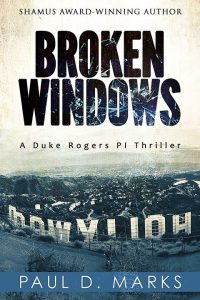
Book Blast | Broken Windows by Paul D. Marks

broken-windows-by-paul-d.-marks-banner

Broken Windows

by Paul D. Marks

October 30, 2018 Book Blast

Synopsis:

Broken Windows by Paul D. Marks

While the storm rages over California’s notorious 1994 anti-illegal alien Proposition 187, a young woman climbs to the top of the famous Hollywood sign—and jumps to her death. An undocumented day laborer is murdered. And a disbarred and desperate lawyer in Venice Beach places an ad in a local paper that says: “Will Do Anything For Money.” Private Detective Duke Rogers, and his very unPC partner, Jack Riggs, must figure out what ties together these seemingly unrelated incidents. Their mission catapults them through a labyrinth of murder, intrigue and corruption of church, state and business that hovers around the immigration debate. Along the way we explore the fiery immigration issue from all sides and no one escapes unscathed.

Book Details:

Genre: Mystery/Crime/Thriller
Published by: Down & Out Books
Publication Date: September 10th 2018
Number of Pages: 360
ISBN: 1948235072 (ISBN13: 9781948235075)
Series: Duke Rogers PI, #2
Purchase Links: Amazon | Barnes & Noble | Goodreads


Read an excerpt:

PROLOGUE

The Hollywood Sign beckoned her like a magnet—or like a moth to a flame. The sign glowed golden in the magic hour sun—that time of day around sunrise and sunset when the light falls soft and warm and cinematographers love to shoot. Like so many others, Susan Karubian had come here seeking fame and fortune, hoping to make her mark on the world. Oh hell, she had come to be a star like all the others. And she would do it, just not quite in the heady way she’d anticipated.

She had spent hours deciding what to wear. After all, this wasn’t exactly in the etiquette books. Probably not the kind of thing you’d find in Ask Amy column. She finally decided on a tasteful dress with high-heeled sandals.

The young woman drove her Passat down Hollywood Boulevard, turning up Franklin, passing the Magic Castle. She turned slowly up Beachwood Canyon, past the low-rent area north of Franklin, up through the towering stone gates with their “Welcome to Beachwood Canyon” signs. Past the movie star homes in the hills—past where she thought she’d be living by now. She drove in circles, past piles of rubble from the earthquake several months ago, figuring that sooner or later she’d hit the right combination of roads and end up where she wanted to be.

The Passat crested the top of the mountain—mountain or hill? What was the difference anyway? A small concrete building with an antenna sat just below the road. No cars. No one around. As quiet as the Sherman Oaks Galleria on a Monday morning. She parked on Mt. Lee Drive.

She rolled up the windows, locked the car, set her purse on the floor by the gas pedal. The note she’d written in a steady hand tucked into her pocket. She hoped someone would find it quickly. Standing beside the car, she realized she’d have to hike down to get to the sign. She had thought it would be at the top of the mountain. She was buggin’, as she treaded toward the edge of the road.

The nonstop rain of the last couple weeks had broken. The view from up here was incredible. You could almost see Mexico to the south and the Pacific glittering in the west. The city below, shiny and bright. Pretty and clean from up here. A million doll houses that reminded her of childhood, playing with dolls and making everything come out the way she wanted it to. Little toy cars down below, scooting back and forth. Swarms of ants scurrying this way and that on important business. Oh yeah, everyone here had important business all day and all night. Everyone but her. She gazed down at Los Angeles on the cusp of the millennium. The place to be. Center of the universe. Totally.

She hesitated at the edge of the road, her toe kicking some gravel down the hill. It clattered down, somehow reminding her of the industrial music in the clubs where she liked to hang.

Should she try to talk to him? What would be the point now? She was talked out. And he wouldn’t forgive her. Why should he? She had hurt him. No, it was beyond hurt. There was no way to rationalize it.

***

Excerpt from Broken Windows by Paul D. Marks. Copyright © 2018 by Paul D. Marks. Reproduced with permission from Paul D. Marks. All rights reserved.


Author Bio:

Paul D. Marks

Broken Windows, the sequel to Paul D. Marks’ Shamus Award-winning mystery-thriller White Heat hit the shelves 9/10/18. Publishers Weekly called White Heat a “taut crime yarn” and said of Broken Windows: “Fans of downbeat PI fiction will be satisfied…with Shamus Award winner Marks’s solid sequel to… White Heat.” Though thrillers and set in the 1990s, both novels deal with issues that are hot and relevant today: racism and immigration, respectively. Marks says “Broken Windows holds up a prism from which we can view the events burning up today’s headlines, like the passionate immigration debate, through the lens of the recent past. It all comes down to the saying we know so well, ‘the more things change, the more they stay the same’.” His short stories appear in Ellery Queen and Alfred Hitchcock Mystery Magazines, among others, and have won or been nominated for many awards, including the Anthony, Derringer and Macavity. His story Windward, has been selected for the Best American Mystery Stories of 2018, edited by Louise Penny & Otto Penzler, and won the 2018 Macavity Award for Best Short Story and was also short-listed for a 2018 Shamus Award. Ghosts of Bunker Hill was voted #1 in the 2016 Ellery Queen Readers Poll. He is co-editor of the multi-award nominated anthology Coast to Coast: Private Eyes from Sea to Shining Sea.

Catch Up With Our Author On:
Website, Goodreads, Twitter, & Facebook!


Tour Participants:

Visit these other great hosts on this tour for more great reviews, interviews, guest posts, and giveaways!


Enter To Win!:

This is a rafflecopter giveaway hosted by Partners in Crime Virtual Book Tours for Paul D. Marks. There will be 1 winner of one (1) Amazon.com Gift Card. The giveaway begins on October 30, 2018 and runs through November 7, 2018. Void where prohibited

a Rafflecopter giveaway


Get More Great Reads at Partners In Crime Virtual Book Tours


The Vampire Knitting Club by Nancy Warren (Showcase & Giveaway)

The Vampire Knitting Club

by Nancy Warren

on Tour October 15 – November 16, 2018

Synopsis:

The Vampire Knitting Club by Nancy Warren

At a crossroads between a cringe-worthy past (Todd the Toad) and an uncertain future (she’s not exactly homeless, but it’s close), Lucy Swift travels to Oxford to visit her grandmother. With Gran’s undying love to count on and Cardinal Woolsey’s, Gran’s knitting shop, to keep her busy, Lucy can catch her breath and figure out what she’s going to do.

Except it turns out that Gran is the undying. Or at least, the undead. But there’s a death certificate. And a will, leaving the knitting shop to Lucy. And a lot of people going in and out who never use the door—including Gran, who is just as loving as ever, and prone to knitting sweaters at warp speed, late at night. What exactly is going on?

When Lucy discovers that Gran did not die peacefully in her sleep, but was murdered, she has to bring the killer to justice without tipping off the law that there’s no body in the grave. Between a hot 800-year-old vampire and a dishy detective inspector, both of whom always seem to be there for her, Lucy finds her life getting more complicated than a triple cable cardigan. The only one who seems to know what’s going on is her cat … or is it … her familiar?

First in a new series of paranormal cozy mysteries!


Book Details:

Genre: Paranormal Cozy Mystery
Published by: Ambleside Publishing
Publication Date: September 2018
Number of Pages: 250
ISBN:13 9781981498970
ASIN: B07HDBQ7BB
Series: The Vampire
Knitting Club #1
Purchase Links: Amazon Goodreads


Read an excerpt:

CHAPTER ONE
Cardinal Woolsey’s knitting shop has appeared on postcards celebrating the quaint views of Oxford, of which there are many. But when a visitor has tired of writing ‘wish you were here’ on the back of pictures of the various colleges, the dreaming spires, and the dome of the Radcliffe Camera, a cozy little shop painted blue, brimming with baskets of wool and hand-knit goods, can be so much more inviting.
My grandmother Agnes Bartlett owned the knitting shop and I was on my way to visit after spending a very hot month at a dig site in Egypt visiting my archeologist parents.
Gran was always ready to wrap her warm arms around me and tell me everything was going to be all right. I needed comforting after discovering my boyfriend of two years Todd had stuck his salami in someone else’s sandwich. I referred to him now as my ex-boyfriend The Toad. I was thinking about Gran’s wisdom, her hugs and her home made gingersnaps, when I started to feel as though cold, wet fingers were walking down the back of my neck.
My wheeled suitcase clanked and rattled behind me along the cobblestones of Harrington Street as I looked around, wondering what had caused the heebie-jeebies.
The October day was chilly and crisp and, in the mid-afternoon, the street was busy with shoppers, tourists and students. Church bells chimed three o’clock. When I glanced ahead, I saw my beloved Gran. She wore a black skirt, sensible shoes and one of her hand-knit cardigans, this one in orange and blue. She was walking with a glamorous woman in her sixties whom I didn’t recognize. I thought Gran looked confused and my hackles immediately rose. The glamor puss was holding an umbrella over Gran’s head, even though the day was dry and there wasn’t a cloud in the sky.
I waved and called, “Gran!” moving faster so my suitcase began to bounce.
I was sure they saw me, but as I sped toward them, they veered down a side street. What on earth? I lifted my case and began to run; though my case was so heavy it was more of a grunting stagger.
“Gran!” I yelled again. I stopped at the bottom of the road where I’d last seen them. There was no one there. A dry, shriveled leaf tumbled toward me and from a window ledge a small, black cat regarded me with what looked like pity. Otherwise, the street was empty.
“Agnes Bartlett!” I yelled at the top of my lungs.
I stood, panting. The side street was lined with a mixture of half-timbered cottages and Victorian row houses, all clearly residential. Gran hadn’t popped into a shop and would soon emerge. She was visiting in one of those homes, presumably. I wondered if it belonged to her friend.
Well, there was no point standing there. I’d go to Cardinal Woolsey’s and wait for Gran there. Her assistant, Rosemary, would be running the shop and I could let myself into the upstairs flat and unpack while I waited for my grandmother to return.
I retraced my steps, but when I reached the entrance to the quaint shop and tried the door, it didn’t open. I tried again, pushing harder, before my other senses kicked in and I realized that no lights were on inside.
A printed sign hung on the windowed front door. It said, “Cardinal Woolsey’s is closed until further notice.” At the bottom was a phone number.
Closed until further notice?
Gran never closed the shop outside her regular closing days. And if she had, where was her assistant?
I stood on the sidewalk that feeling came again, like cold fingers on the nape of my neck.
***

Excerpt from The Vampire Knitting Club by Nancy Warren. Copyright © 2018 by Nancy Warren. Reproduced with permission from Nancy Warren. All rights reserved.


Author Bio:

Nancy Warren

Nancy Warren is the USA Today bestselling author of more than 60 novels including the Toni Diamond cozy mystery series.

She shares her time between Victoria, British Columbia, and Bath in the UK.

Catch Up With Nancy Warren On:
nancywarren.net, Goodreads, Twitter, & Facebook!


Tour Participants:

Visit these other great hosts on this tour for more great reviews, interviews, guest posts, and giveaways!


Enter To Win:

This is a rafflecopter giveaway hosted by Partners in Crime Virtual Book Tours for Nancy Warren. There will be one (1) winner of one (1) Amazon.com Gift Card. The giveaway begins on October 15, 2018 and runs through November 17, 2018. Void where prohibited.

a Rafflecopter giveaway


Get More Great Reads at Partners In Crime Virtual Book Tours

THREE STRIKES by Ross Klavan, Tim O’Mara and Charles Salzberg (Showcase & Guest Post)

Three Strikes

by Ross Klavan, Tim O’Mara, and Charles Salzberg

on Tour September 1 – October 31, 2018

Synopsis:

Three Strikes by Ross Klavan, Tim O'Mara, and Charles Salzberg

I Take Care of Myself in Dreamland

by Ross Klavan

Bartok is horribly scarred. Wounded in the Army, he roams through 1970’s New York, a city of perpetual night, punctuated by crime and populated by streetwalkers, hooker bars, strip clubs, easy drugs and a feeling of doom. There’s one thing on his mind: an experience he had when his Army truck exploded, an experience he calls Red River. More than bliss, more than spiritual. But nothing goes right. Bartok loses his girl, his money, any possibility of support and decides that he’s finished, he’s going to end it but before he does, he’s going out on the town for one last attempt to recapture the incredible experience of Red River. And when he does, he runs into others who see him as an easy mark for dirtier plans…plans that involve murder before suicide.

Bartok’s story is told by a driver for the mob, a guy who’s heard it all and usually keeps his mouth shut because when he begins a trip, it’s almost always one-way.

Jammed

by Tim O’Mara

Aggie’s back. After barely escaping with his life in “Smoked,” Aggie disproves the old adage of “Once burned…” This time around he’s heading from the Midwest to New York City with a sweet shipment of stolen maple syrup. He also has picked up an unwanted-and potentially dangerous-passenger; the fifteen-year-old daughter of his latest boss has hopped on for a free ride to the Big Apple and her on-line boyfriend. When they arrive in NYC, Aggie’s worst fears are realized when the “boyfriend” turns out to be a group of human traffickers. Aggie knew that running one of the world’s most valuable liquids across state lines was skirting the line between safety and danger, but he never knew it could get this sticky.

The Maybrick Affair

by Charles Salzberg

It’s a couple weeks before the attack on Pearl Harbor and a young reporter, Jake Harper, who works for a small Connecticut newspaper, is assigned a routine human interest story. A reclusive, elderly woman, has quietly passed away in her small cottage upstate. Anxious for bigger stories, Jake begins his assignment by trying to find out who this woman was and what kind of life she led. As Jake investigates the old woman’s death he finds that years earlier she was tried and convicted of murdering her husband in a well-publicized, lurid trial in London, England. And, after digging further, he, unearths evidence that she might have had a connection to an even more famous British serial killer and that the ramifications of this story might affect America’s entry into the War.


Check out my review HERE and enter the giveaway!

Book Details:

Genre: Crime
Published by: Down & Out Books
Publication Date: September 10th 2018
Number of Pages: 350
ISBN: 978-1-948235-25-9
Series: 3 Authors, 3 Novellas
Purchase Links: Down & Out Books | Amazon | Barnes & Noble | Goodreads


Our Authors:

Ross Klavan, Tim O'Mara, and Charles Salzberg

Ross Klavan

Ross Klavan’s work spans film, television, radio, print, live performance and visual art. A novella, “Thump Gun Hitched,” was published in 2016 by Down and Out Books as part of “Triple Shot” along with Charles Salzberg and Tim O’Mara. His darkly comic novel Schmuck was published by Greenpoint Press in 2014. Klavan’s original screenplay for the film Tigerland was nominated for an Independent Spirit Award and the film was released by New Regency starring Colin Farrell. He recently finished an adaption of John Bowers’ The Colony and has written scripts for Miramax, Intermedia, Walden Media, Paramount, A&E and TNT-TV among others. The “conversation about writing” he moderated with Kurt Vonnegut and Lee Stringer was televised and published as Like Shaking Hands with God, and his short stories have appeared in magazines and been produced by the BBC. An earlier novel, Trax, was published under a pseudonym. His play How I Met My (Black) Wife (Again), co-written with Ray Iannicelli, has been produced in New York City, and he has performed his work in numerous theaters and clubs. He has acted and done voice work in TV and radio commercials and has lent his voice to feature films including: Casino, You Can Count on Me, Revolutionary Road, Awake and the Amazon web series Alpha House, written by Gary Trudeau. He has worked as a newspaper and radio journalist in New York City and London. He lives in New York City with his wife, the painter, Mary Jones.

Catch Up With Ross Klavan On: Goodreads, Twitter, & Facebook!


Tim O’Mara

TIM O’MARA is best known for his Raymond Donne mysteries about an ex-cop who now teaches in the same Williamsburg, Brooklyn, neighborhood he once policed: Sacrifice Fly (2012), Crooked Numbers (2013), Dead Red (2015), Nasty Cutter (2017), published by Minotaur Books (#1–#3) and Severn House (#4). He recently signed a deal for a fifth Raymond book, The Hook, which should be published in late 2019 by Severn House. His novellas Smoked and Jammed appear in 2016 and 2018 crime trilogies from Down & Out Books. O’Mara taught special education for 30 years in the public middle schools of New York City, where he still lives and teaches adult writers. In addition to writing The Hook and the stand-alone high-school-based crime drama So Close to Me, O’Mara is currently curating a short crime story anthology to benefit the non-profit American Rivers.

Catch Up With Our Author On: timomara.net, Goodreads, Twitter, & Facebook!


Charles Salzberg

Charles Salzberg is a former magazine journalist and nonfiction book writer. He is the author of the Shamus Award nominated Swann’s Last Song, and the sequels, Swann Dives In, Swann’s Lake of Despair and Swann’s Way Out. His novel, Devil in the Hole, was named one of the best crime novels of 2013 by Suspense magazine. His latest novel is Second Story Man. He is co-author of Triple Shot, with Ross Klavan and Tim O’Mara (three crime novellas). He teaches writing in New York City and is on the board of the New York chapter of Mystery Writers of America.

Catch Up With Charles Salzberg On: charlessalzberg.com, Goodreads, Twitter, & Facebook!


Guest Post by Charles Salzberg


What inspired you to write your first book?

I’m going to skip over the inspiration for my first book, which I began to write when I was 12-years old, primarily because I never finished it. It was a roman a clef (I don’t even think I had a title for it) based on several unhappy summers spent at sleepaway camp. I’d recently learned how to touch type—the most useful course I’ve ever taken in school—and was eager to put my new skill to work. I thought those three or four single-spaced pages were lost forever, but when I moved apartments a few years ago, I found them. Don’t bother asking about them, though, because I haven’t worked up enough nerve yet to actually read them. But I will. Maybe.

I guess the inspiration for my first completed novel, for writing all subsequent novels, in fact, came from reading the work of Saul Bellow, Seize the Day, Herzog, and The Adventures of Augie March, Bernard Malamud, The Fixer and The Natural, Salinger’s Catcher in the Rye, and Norman Mailer’s, Naked and the Dead.
But the actual inspiration for my first completed novel, The Executioner, came from a yearly feature in the Village Voice. The novel is not what you think, an action-packed tale about a ruthless hitman, but rather a moody, literary novel about a middle-aged man who feels his life is meaningless, and is searching for something he can do to make the world a better place. One day, he reads a feature story in the Voice naming the 10 worst landlords in New York City. One of them acts so egregiously, intimidating tenants so they’ll move and he can hike up the rents, failing to provide basic services like heat and hot water, that the protagonist decides his contribution to society will be to rid the world of this horrible man (mind you, I was only in my early twenties when I wrote this novel, so how I thought I knew anything about mid-life crises is beyond me). The novel was never published but it did find me an agent, make me a finalist in for a prestigious fellowship, and serve as a writing sample to get me into an MFA program.

The inspiration for my first published novel, Swann’s Last Song, was an insult. I’d been accepted into the MFA program at Columbia and before classes began I met with my advisor, a pompous published author of middling and certainly not critically acclaimed novels. Our meeting consisted of him berating me because he said I wrote “that psychological crap like Roth and Doestoevsky” (pretty good company, I thought), and then he added gratuitously, “don’t you know what a story is?”

Yeah, I knew what a story was. I was an English major. I’d read hundreds of novels and short stories. The above mentioned The Executioner, was what got me into the program in the first place. Then he delivered the coup de grace, “if you can forget everything you think you know about writing, I can teach you how to be a good writer.” Yeah, right. I quit the program a week later.

But his words stuck in my mind. Of course, I can tell a story. I know exactly what a plot is. I wanted to prove it to him and me and everyone else in the world, so I decided I would write the most heavily plotted kind of book I could think of: a detective novel. So, I read dozens of crime novels: Chandler, Hammett, Nero Wolfe, John D. MacDonald, James M. Cain, Big Jim Thompson, Charles Willeford, anyone I could get my hands on.

And then I began to write. The result was Swann’s Last Song, which languished in a desk drawer for almost twenty years before it was finally published.

Oh, by the way, it was nominated for a Shamus Award for Best First PI Novel.

All of this suggests, at least in my case, that revenge is a very powerful form of inspiration.


Read an excerpt:

I Take Care of Myself in Dreamland
By Ross Klavan

 
It was a great time for whores.

New York City, 1970, ’71 maybe, ’72, but, as Bartok was saying, “If nothing else, it’s an ace of a time to be a hooker.” In fact, he says, maybe it’s a lousy time to be anything else. This is what Bartok is telling us he told the whore he’s with, standing in the fleabag hotel on Lex across from Grand Central. Something like, “Must be a great time to be turning tricks.”

Now, a certain kind of guy won’t tell you this but—it doesn’t bother me a damn bit that I’m stupid. Plenty of people would mind—I don’t. They’d be embarrassed—I’m not. When I was a kid they use to say to me, “You don’t have the brains you were born with.” And you know what? They were right. Or maybe I did have those brains, maybe I was born this way. Whatever it is, “stupid” is the reason I’m still around.

The way I see it, I’m just smart enough to keep my mouth shut and at this age—I’m an old man now—you get to see that being smart enough to zip the yap is all the smarts you need. If you take the trip and make your way around, what you’ll end up with anyway is lots of stories you can tell in a bar when nobody wants to listen. So, it’s okay that I’m stupid. Back then, I kept myself dumb except to sometimes say something stupid to make them all laugh. That’s all.

That’s why they let me drive. The smart guys? They didn’t last so long. Smart guys or guys trying to be smart. They’re always the ones who get it first.

“You’re an interesting guy,” they said to me. “You’re the only dumb Yid I’ve ever met.” I told them I was proud to show them that it takes all kinds.

So. Bartok. I’m driving, he’s in the back seat between Nicky and Ray, and he can’t keep his mouth shut, he keeps on chattering like Mr. Happy and he has this strange way of saying things like that he was a guy who “travels the night city, the dark arsenal of bad dreams.”

I said, “You’re a real poet,” and he agreed. I knew he wasn’t gonna last too long.

In the back seat, Bartok shoves his voice down into a whisper so that he sounds like he’s got some hot, evil secret to get off his chest—that’s the way he tells us that he likes hookers except the thing is, they usually don’t take to him. I’m thinking that if this is gonna be his confession, then it’s his last one. “So you’re a guy that even hookers won’t go with,” I say to him. “Man, you ain’t gonna miss much in this world.”

“I can’t say,” Bartok says and it’s the only time he gets so agitated that Ray and Nicky hold him back on the seat. “I can tell.” And then he goes on about the hotel room and how he’s trying to be so cool and charming because, like he says, he’s got this thing for hookers. He likes scotch and hookers he says, and that’s about everything. That’s his entire life. That, and Red River.


Jammed
By Tim O’Mara


“I oughta shoot you where you stand.”

I know, but I swear to God, that’s exactly what he said. With all I’d been through in the past day and a half, I almost laughed, and I woulda, except he had this huge-ass gun pointed at my face. I guess all guns look big when they’re pointed at you. Forget about it being the biggest cliché in the world, but I was sitting at the time. In his pickup truck. A beautiful red pickup truck. I tell ya, if ya ever commit a crime in the Midwest, make your getaway vehicle a red pickup truck. Soon as you hit the highway, you’ll blend in like a sore thumb in a podiatrist’s office. A sore toe is more like it, but I don’t know what they call hand doctors, so…whatever. You know what I mean.

Truth be told, I was surprised he said anything to me at all. If I was him, I’da shot my ass before I got into his truck. Make sure I didn’t get any blood on the seats. That’s if I was him. Me? I couldn’t shoot someone who wasn’t trying to shoot me. Or maybe trying to hurt a loved one, I guess, y’know? I especially couldn’t shoot someone who comes to a gunfight with a set of keys, which is all I had on me when I got in his truck. That, my driver’s license, and an expired credit card. I think back on it, if I did laugh, it woulda been more than likely my last laugh. My momma used to say, “He who laughs last, laughs best.”

She’da been wrong this time, though. He who laughed last mighta got his ass blown all the way to hell.

Anyway, that was my cook talking, the guy I got my meth from. I screwed up trying to go big league with him. I shoulda learned my lesson and stayed small time and just kept on going with the flow. Sitting next to my cook, in the back seat of the pickup, was that guy Robert who owned the ranch, and was gonna pay me, Elmore, and Mickey to drive those illegal cigarettes to Illinois.

You know things are going to shit when three guys ride out and only two ride back. Somebody wrote a song like that a buncha years ago. The Byrds? The Eagles, maybe?

So, there I am in the back of a pickup, sitting across from my cook and Robert, and I very slowly reach behind me and pull out the money I owed them. What I had left of it, anyway. Robert took it and did that thing like he was weighing it in his hands, letting me know that had the deal gone the way it was supposed to, he’d be holding a lot more money than I’d just given him, we’d be talking about the next deal, and I wouldn’t have a gun sticking in my face.
Nobody talked for a few minutes and I sure as shit wasn’t gonna be the first one to strike up a conversation. I could tell they were both deciding what to do with me and none of the things I came up with in my head were good. Next thing I know, they both take out their phones and start texting. That confused the shit out of me, but after a little while it dawned on me—the way Cook texted and then Robert’s phone would ding and then he’d text and Cook’s phone would ding—that they were texting each other. About me.


The Maybrick Affair
By CharlesSalzberg


1

If there’s anything more boring, make that deadly boring, than a town council meeting I’ve yet to experience it. But when you’re a young reporter for a small newspaper in a small state—Connecticut—and you’re low man on the totem pole, you don’t have much choice in what you cover. Thank goodness, I only have to do it once a month or in the unlikely event an emergency meeting is called.

It’s not exactly what I had in mind when I broke into journalism after graduating from Yale a couple years ago. I can hardly budget my own meager salary much less understand the town’s budget, and the idea of sitting through lengthy, mostly pointless discussions about traffic violations, Christmas festivals, parades and holiday decorations, well, let’s just say I can think of at least a dozen better uses of my time.

The truth is, not much goes on up here, so you wind up praying for something big, like a multi-car pile-up, a domestic dispute, a burglary, or even a small fire. Nothing too serious, just anything to break the monotony.

But it’s my job to be here, and so I make sure I pay attention and take good notes, which I’ll have to decipher later, since my handwriting leaves much to be desired. My friends used to joke that with that scrawl I should have been a doctor. Not much chance of that, since I gag at the sight of blood.

The way I figure it, I’m just biding my time, paying my dues, impressing my boss with my work ethic in hopes he’ll see he’s wasting me on crap like this and gives me something more interesting. Something like the crime beat. Not that there’s all that much crime up here, but every so often there is a break-in or a domestic squabble, or some two-bit white-collar crime that can possibly make it below the fold on the front page.

I am a fish out of water, living and working in a small town like New Milford. I’m a city kid, born and raised in New York City. Yorkville, to be precise, which is on the upper east side of Manhattan. I literally grew up on the wrong side of the tracks, the tracks of the elevator train, also known as the subway or just plain el. The wrong side of the tracks in this case being east of Park Avenue. My family isn’t German, Czech or Hungarian, but that’s who mostly inhabit my neighborhood and that heritage is reflected in the local restaurants and bakeries, places like the Bremen House, Geiger’s, Schaller and Weber, and Kleiner Konditorei,
A small-town council meeting is a stretch for me, especially since the usual issues under discussion are so provincial and, for the most part, intrinsically uninteresting, at least to me.

***

Excerpt from Three Strikes by Ross Klavan, Tim O’Mara, and Charles Salzberg. Copyright © 2018 by Ross Klavan, Tim O’Mara, and Charles Salzberg. Reproduced with permission from Down & Out Books. All rights reserved.


Tour Participants:

Visit these other great hosts on this tour for more great reviews, interviews, guest posts, and giveaways!


Get More Great Reads at Partners In Crime Virtual Book Tours


Death By The River by Alexandrea Weis and Lucas Astor (Showcase, Interview & Giveaway)

Beneath The River by Alexandrea Weiss and Lucas Astor Banner

Death by the River

by Alexandrea Weis and Lucas Astor

on Tour October 1 – November 30, 2018

Synopsis:

Death by the River by Alexandrea Weis and Lucas Astor

A High School “American Psycho

SOME TRUTHS ARE BETTER KEPT SECRET.
SOME SECRETS ARE BETTER OFF DEAD.

Along the banks of the Bogue Falaya River, sits the abandoned St. Francis Seminary. Beneath a canopy of oaks, blocked from prying eyes, the teens of St. Benedict High gather here on Fridays. The rest of the week belongs to school and family—but weekends belong to the river.

And the river belongs to Beau Devereaux.

The only child of a powerful family, Beau can do no wrong. Handsome. Charming. Intelligent. The star quarterback of the football team. The “prince” of St. Benedict is the ultimate catch.

He is also a psychopath.

A dirty family secret buried for years, Beau’s evil grows unchecked. In the shadows of the ruined St. Francis Abbey, he commits unspeakable acts on his victims and ensures their silence with threats and intimidation. Senior year, Beau sets his sights on his girlfriend’s headstrong twin sister, Leslie, who hates him. Everything he wants but cannot have, she will be his ultimate prize.

As the victim toll mounts, it becomes crystal clear that someone has to stop Beau Devereaux.

And that someone will pay with their life.

Book Details:

Genre: Young Adult, Horror, Thriller
Published by: Vesuvian Books
Publication Date: October 2, 2018
Number of Pages: 389
ISBN: 1944109145 (ISBN13: 9781944109141)
Purchase Links: Amazon | Barnes & Noble | Goodreads


Alexandrea Weis:

Alexandrea Weis

Alexandrea Weis, RN-CS, CRRN, ONC, PhD, is a multi award-winning author of twenty-five novels, a screenwriter, ICU Nurse, and historian who was born and raised in the French Quarter of New Orleans. Having grown up in the motion picture industry as the daughter of a director, she learned to tell stories from a different perspective and began writing at the age of eight.

Infusing the rich tapestry of her hometown into her novels, she believes that creating vivid characters makes a story moving and memorable.

A permitted/certified wildlife rehabber with the Louisiana Wildlife and Fisheries, Weis rescues orphaned and injured animals. She lives with her husband and pets in New Orleans. Weis writes paranormal, suspense, thrillers, horror, crime fiction, and romance.

Q&A with Alexandrea Weis

Welcome!
Writing and Reading:

Do you draw from personal experiences and/or current events?

I draw from a lot of personal experiences. As a nurse for over twenty-five years I have had a lot of experience with the human condition—good and bad. It has made me a better writer.

Do you start with the conclusion and plot in reverse or start from the beginning and see where the story line brings you?

I always start at the beginning and see where the story brings me. I like to surprise myself as I write, and I never plot out a story because I never stick with it.

Are any of your characters based on you or people that you know?

Some characters in every book I write are based on the people I know. Makes them more relatable for me and the reader.

Your routine when writing? Any idiosyncrasies?

I just sit and write. I spend several hours a day writing, so it has become a habit for me.

Tell us why we should read this book.

Death by the River is an entertaining and riveting in-depth look at a man’s descent into depravity and the psychological instability he suffers from. How he manifests his fantasies by hurting the innocent also ignites the need for revenge in the women he harms. How his mental illness develops, and how it affects others, is the crux of the story. Beau Devereaux for me is a fascinating character.

Who are some of your favorite authors?

Ian Fleming, Mary Renault, Charles Dickens.

What are you reading now?

ISAN: International Sensory Assassin Network by Mary Ting

Are you working on your next novel? Can you tell us a little about it?

My next YA (historical) novel is complete and will be out in May 2019. Realm (Vesuvian Books) is about the sixteen-year-old Persian wife of Alexander the Great—Roxana. The daughter of a local governor in Bactria, Alexander married her and took her with him on his travels across Persia and India. It is about her time with him and the years after his death when she is bounced around his myriad of generals who are vying for control of his empire. It is an epic tale of love, conquest, and the plight of women in ancient times. History tells his story. This is hers.

Fun questions:
Favorite leisure activity/hobby?

I’m a runner. When I am not writing, I am working out on my treadmill.

Favorite meal?

French fries.

Thank you for stopping by CMash Reads and spending time with us.


Catch Up With Our Alexandrea On:
Website, Goodreads, Twitter, & Facebook!


Lucas Astor:

Lucas Astor

Lucas Astor is from New York, has resided in Central America and the Middle East, and traveled through Europe. He lives a very private, virtually reclusive lifestyle, preferring to spend time with a close-knit group of friends than be in the spotlight.

He is an author and poet with a penchant for telling stories that delve into the dark side of the human psyche. He likes to explore the evil that exists, not just in the world, but right next door behind a smiling face.

Photography, making wine, and helping endangered species are just some of his interests. Lucas is an expert archer and enjoys jazz, blues, and classical music.

One of his favorite quotes is: “It’s better to be silent than be a fool.” ~Harper Lee (To Kill a Mockingbird)


Read an excerpt:

Crickets chirped and mist curled around him as Beau eased out of the crack in the wall to the cells. The chill in the air teased his sweaty skin, but the surge of power pounding through his blood was like liquid fire.

The rush consumed him. He knew in that instant he would find another victim, but his rational mind begged him to be careful.

Don’t get caught.

He chuckled. Besides the money, his father still had hefty political clout in Baton Rouge, thanks to his notorious grandfather and years of murky business dealings. The family name had spared him in the past from legal proceedings and institutions. It would again.

Heading toward the fountain across the grassy field, Beau considered his next night of fun. Before he reached the forgotten angel, a flash in the corner of his eye made him turn.

Amid the trees, crowding the edge of the property, something darted in and out. He could just make out a long, white hooded cloak, fluttering and billowing at the edge of the woods. Then it disappeared.

His heart rocketed to his throat. It can’t be!

All the stories he’d heard of the lady in white of The Abbey came rushing back at once, intensifying his panic.

Then he calmed. Someone had to be messing with him. It wasn’t the girl. Kelly had taken off, a bawling mess, across the field several minutes before and he’d heard the slam of the iron gate. He was alone. Unless … the guys had pulled a fast one on him.

But the guys don’t know about your room in the cells.

Beau cut across the grass, anxious to get to the iron gate and back to the party. Almost to the path, he glanced back over his shoulder to the patch of trees where he had seen the ghostly presence. Nothing was there.

It was just your imagination. Or was it?

He made it to the party at the beach, relieved to be back among people, but the incident with the ghost had eradicated his high.

He hungered for it to return but would have to wait.

***

Excerpt from Death by the River by Alexandrea Weis and Lucas Astor. Copyright © 2018 by Alexandrea Weis and Lucas Astor. Reproduced with permission from Vesuvian Books. All rights reserved.


Tour Participants:

Tour Participants:

Visit these other great hosts on this tour for more great reviews, interviews, guest posts, and giveaways!


Enter To Win:

This is a rafflecopter giveaway hosted by Partners in Crime Virtual Book Tours for Vesuvian Media Group. There will be 1 winner of one (1) Amazon.com Gift Card. The giveaway begins on October 1, 2018 and runs through December 3, 2018. Void where prohibited.

a Rafflecopter giveaway


Get More Great Reads at Partners In Crime Virtual Book Tours


DEAD IN THE DARK by Stephen Booth (Guest Post, Showcase, & Giveaway)

Dead in the Dark

by Stephen Booth

on Tour September 25 – October 25, 2018

Synopsis:

Dead in the Dark by Stephen Booth

How do you prove a murder without a body?

Ten years ago, Reece Bower was accused of killing his wife, a crime he always denied. Extensive police searches near his home in Bakewell found no trace of Annette Bower’s remains, and the case against him collapsed.

But now memories of the original investigation have been resurrected for Detective Inspector Ben Cooper – because Reece Bower himself has disappeared, and his new wife wants answers.

Cooper can’t call on the Major Crime Unit and DS Diane Fry for help unless he can prove a murder took place – impossible without a body. As his search moves into the caves and abandoned mines in the isolated depths of Lathkilldale, the question is: who would want revenge for the death of Annette Bower?


Book Details:

Genre: Mystery
Published by: Witness Impulse
Publication Date: September 25, 2018
Number of Pages: 384
ISBN: 0062876104 (ISBN13: 9780062876102)
Series: Cooper & Frye Mysteries #17
Purchase Links: Amazon | Barnes & Noble | Goodreads


Guest Post by Stephen Booth

10 things that readers don’t know about Detective Inspector Ben Cooper

  1. Ben Cooper’s birthday is in late June, so his star sign is Cancer (like mine!).
  2. He broke his arm as a child when his older brother Matt pushed him off his bike. He still gets a twinge of pain in the winter.
  3. Like many children who grew up on a farm, Ben once had pet lamb that had lost its mother. He called it Norman.
  4. As a teenager, his first girlfriend’s name was Stephanie. She was the daughter of a local veterinary surgeon, but she dumped him when he announced he was joining the police.
  5. Ben barely scraped good enough grades at school to qualify as a police cadet – unlike his colleague Diane Fry, who is a university graduate in Crime and Policing.
  6. However, after his day-to-day experience as a cadet and a police constable, he passed his sergeant’s exams with flying colours.
  7. Ben played rugby for a while, as a wing threequarter with Edendale rugby club, but a bad tackle during a match against Buxton aggravated his old injury.
  8. As a uniformed police constable, he was once called to an incident of domestic violence and had to single-handedly tackle a man armed with a knife, for which he received a Chief Constable’s commendation.
  9. On his desk in his office, Ben Cooper has an aerial view of Bank End Farm, where he grew up.
  10. He doesn’t have much time for reading because of his job, but when he does he enjoys historical fiction like Bernard Cornwell or Simon Scarrow. He rarely reads crime novels, because he finds them too unrealistic.


Stephen Booth

Author Bio:

A former newspaper journalist, British author Stephen Booth is the creator of two young Derbyshire police detectives, Ben Cooper and Diane Fry, who have appeared in 17 crime novels, all set in and around England’s Peak District.


Catch Up With Stephen Booth On:
stephen-booth.com
Goodreads
Twitter
Facebook


Read an excerpt:

Chapter One

No one wants to die in the dark. To lie alone in the blackness, feeling the chill of death creep slowly over you. Shut away from the light as the fear numbs your limbs and chokes the breath in your throat. The long, long sinking into the cold depths. And then to sense that slipping away. The final slipping away into nothing.

Do you feel that stab of pain as it shoots through your chest? Try to make your breathing more shallow. You have several broken ribs, a fractured arm, perhaps a punctured lung. You can hardly know, in the dark. But you can feel the internal bleeding, the seeping blood as it squeezes your internal organs, bloats your stomach and intestines. You know your injuries are fatal.

That fear of the dark is overwhelming. Because this is true darkness, an eternal night in which your eyes have become useless. Your heart thumps uselessly as you strain to see where you’re lying. You can sense space around you, a slight movement of icy air, a shifting of heavy masses, a solid weight way above your head. A sharp, stabbing pain is in your back from something hard you’re lying on. This isn’t a grave. But it is your tomb.

Does your fear of the dark make any sense? When you’re dead, you go into endless blackness. Yet you’ve always hoped you would get one last glimpse of the light, always prayed that you wouldn’t die alone.

Well, that’s not going to happen. There’s nothing for you to see here. Not a glimmer of light, not a flicker of hope. Only the darkness.

A creak and a rattling makes you freeze. Is someone here? Or some thing? But no . . . you breathe out and release the pain. The noise has quite a different meaning. It’s something huge shifting overhead. It signals the end, the approach of your death. You’re about to be crushed completely.

***

Excerpt from Dead In The Dark by Stephen Booth. Copyright © 2018 by Witness Impulse. Reproduced with permission from Witness Impulse. All rights reserved.


Tour Participants:

Visit these other great hosts on this tour for more great reviews, interviews, guest posts, and giveaways!


Enter the Giveaway!:

This is a rafflecopter giveaway hosted by Partners in Crime Virtual Book Tours for Harper Collins/Witness Impulse. There will be 3 winners of one (1) copy of SECRETS OF DEATH by Stephen Booth (eBook). The giveaway begins on September 25, 2018 and runs through October 26, 2018. Open to U.S. addresses only. Void where prohibited.

a Rafflecopter giveaway


Get More Great Reads at Partners In Crime Virtual Book Tours